Fish Belly Weir Gates at the Calverley Flood Storage Reservoir (FSR), located within the River Aire valley
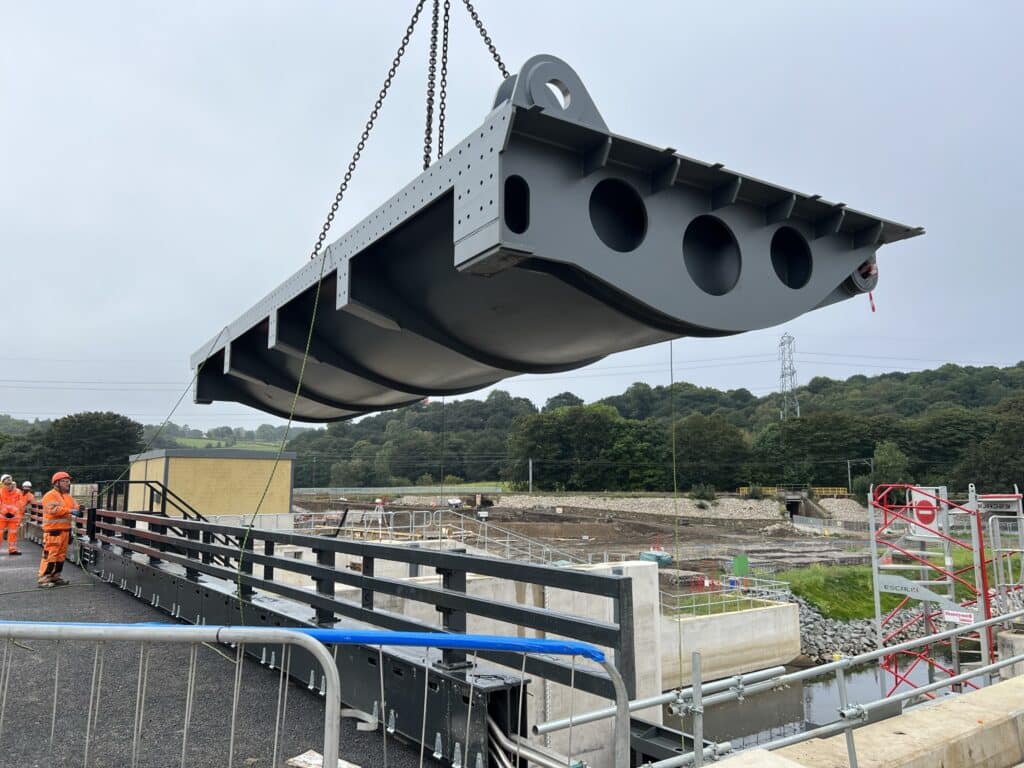
The Calverley Flood Storage Reservoir (FSR), located within the River Aire valley, is part of the Leeds Flood Alleviation Scheme (FAS). It comprises an embankment across the floodplain, and a flood defence in the form of two fish belly flood gates which were manufactured and installed by our team.
The works were constructed by the joint venture between our client, Mott MacDonald and BAM (BMMJV), on behalf of Leeds City Council. The Flood Storage Reservoir controls the river flow downstream and prevents flooding in the city.
What work was done by Qualter Hall at the Calverley Flood Storage Reservoir?
- Two fishbelly weir gates were designed by our external design partner, KGAL Consulting Engineers Ltd, and detailed by our own in-house design team.
- The flood gates themselves were manufactured by Qualter Hall in our Barnsley workshop - through fabrication, welding, machining, painting and factory acceptance testing, before final onsite installation.
- Our in-house engineering team and hydraulics specialist collaborated with Hedley Hydraulics and Montan Cylinders to design and manufacture the hydraulic system for the project.
- Our in-house Controls team designed and supplied the control system and software required to operate the flood gates.
- Qualter Hall also provided training to operators and maintainers of the flood control structure. This was the final phase of our involvement in the project, and we have had sign-off from BAM on satisfactory completion.
How does the fish belly gate flood defence work at Calverley Flood Storage Reservoir (FSR)?

The flood defence is set into the river channel and houses two hydraulically operated fish-belly flap gates, complete with maintenance stoplogs.
The gates lie flat at the bottom of the river during normal conditions and raise when water levels exceed the peak flow*. This channels flood water into the reservoir to prevent the river overtopping the linear defences downstream. The gates sit beneath the water line of the river, even when they are raised to hold the water back. The photo shows the dry structure during construction.
Gate hydraulic operating systems are situated on the dam crest, adjacent to the flood defence, and electrical control panels and a standby generator are housed in a control building at the northern end of the embankment.
Monitoring instrumentation is located at Calverley Bridge, downstream of the Flood Storage Reservoir. This monitors the river levels to control the hydraulic gates and manage the water flowing forwards down the River Aire into central Leeds.
Calverley Flood Storage Reservoir (FSR) provides storage for 1.8M cubic meters of flood waters, resulting in an increase in the standard of protection to downstream communities. The weir gates reduce the risk of flooding along the 20km stretch of the River Aire from the outer ring road to the west of the city, through the city centre and past Stourton.
*Peak flow is defined as ‘1-in-100’ AEP flood event.